

Mansi Khamkar
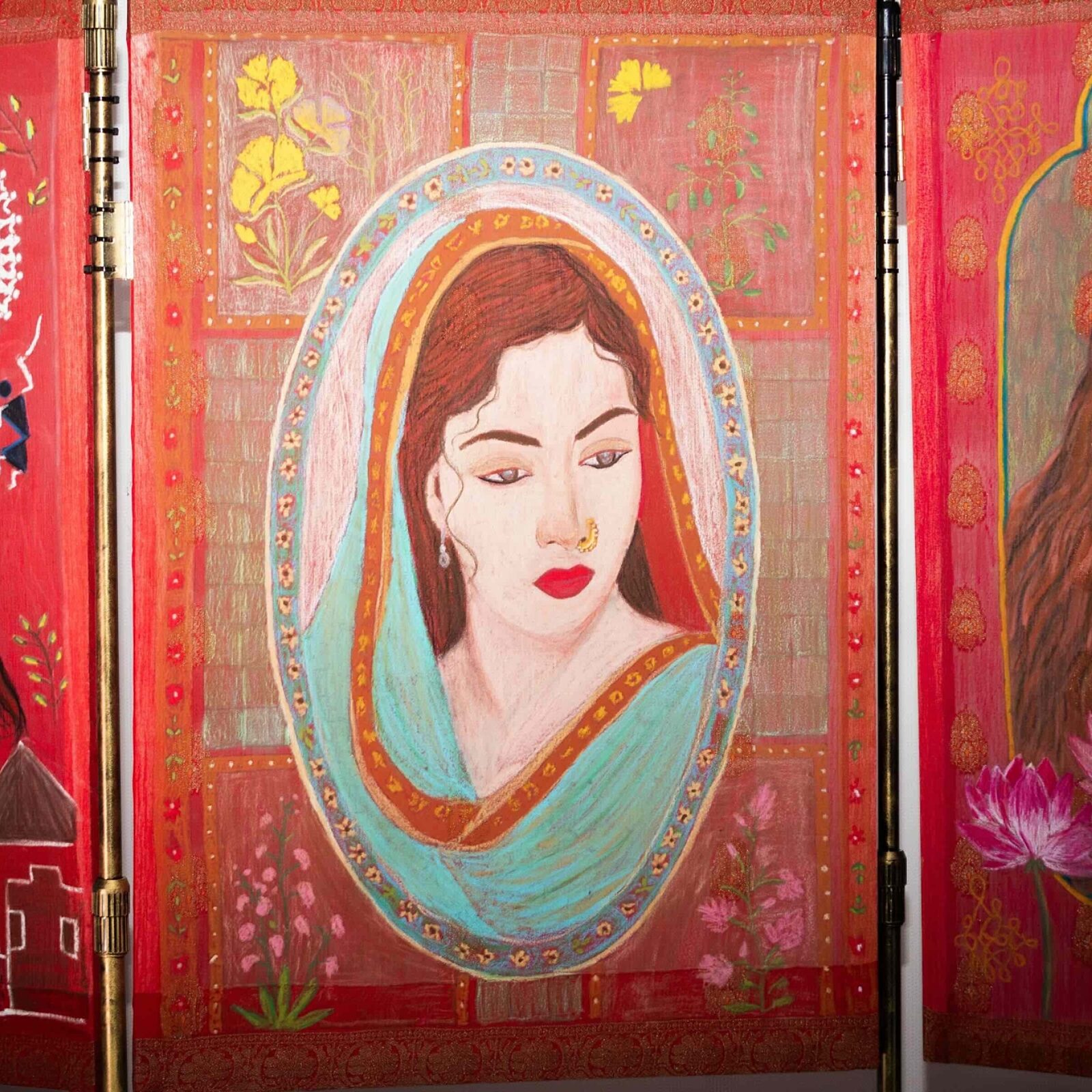
Artist Statement:
My name is Mansi Khamkar, and I studied for an MFA in Fine Art at Nottingham Trent
University. My present artistic practice investigates the link between female portraiture,
pattern, textiles, memory, and cultural heritage. I use painting, fabrics, and installation in
my art, utilizing the saree as the medium for my creative expression. The importance of the
saree in my artistic practice lies in its being a medium full of memories of the body,
domestic life, my ancestry, and migration. Working with my mother’s saree is not an act of
working on the canvas; it is an interaction with a loaded medium.
Pattern has become an essential visual language in my practice. I have used motifs such as
flowers, textile borders, architectural elements, recurring signs, and folkloric imagery to
create patterns that surround and contain the female form. The pattern is more than
decoration; it evokes protection, containment, repetition, rituals, and ancestral identity. I
find the notion of how patterns can imprison women by holding their memories, silences,
cultures, and emotions fascinating.
In my previous works, I often used headless female figures to explore concepts such as
lack, disappearance, and anonymity. In my recent works, however, I have once again
started including a face. This is indicative of my journey from lack to presence. The women
depicted in my paintings are not meant to be representations of fixed identities.
Material experimentation is an important part of my practice. I apply paint, oil pastel, and
mixed media directly on cloth, and the way the material is woven, soft, and moves
influences my gestures. I am also exploring the process of folding, dying, stitching, and
embroidery in my work. This process establishes links among painting, the body, domestic
practices, and crafts traditionally made by women.
My installations exist in the spaces between painting, textile object, and memory of space.
Folded structures enable the work to be revealed, hidden, and fragmented, mirroring how
memory can be held, transformed, and reconstructed. Through my work I hope to develop
a visual language for the present day that connects personal experience with larger themes
of migration, femininity and heritage.